Disclaimer
Last updated: October 28, 2026
Welcome to onerepmaxlab. This page explains what our one rep max calculator, training guides, and strength standards can and cannot do for you. Please read it before you load the bar.
Before You Lift: Safety and Health
Educational content, not professional advice. “This OneRepMaxLab disclaimer explains how to use our calculator and content responsibly.” Everything on onerepmaxlab.com is written to help lifters understand strength training. That covers our 1RM calculator, programming articles, percentage charts, and strength level benchmarks. None of it is medical advice, a diagnosis, or a personalized exercise prescription. It does not replace a doctor, physiotherapist, or certified strength and conditioning coach.
Check in with a professional first if you have an injury, a heart or blood pressure concern, joint problems, are pregnant or recovering from surgery, or have any condition that could affect how your body handles heavy loading. Never delay or ignore professional care because of something you read here.
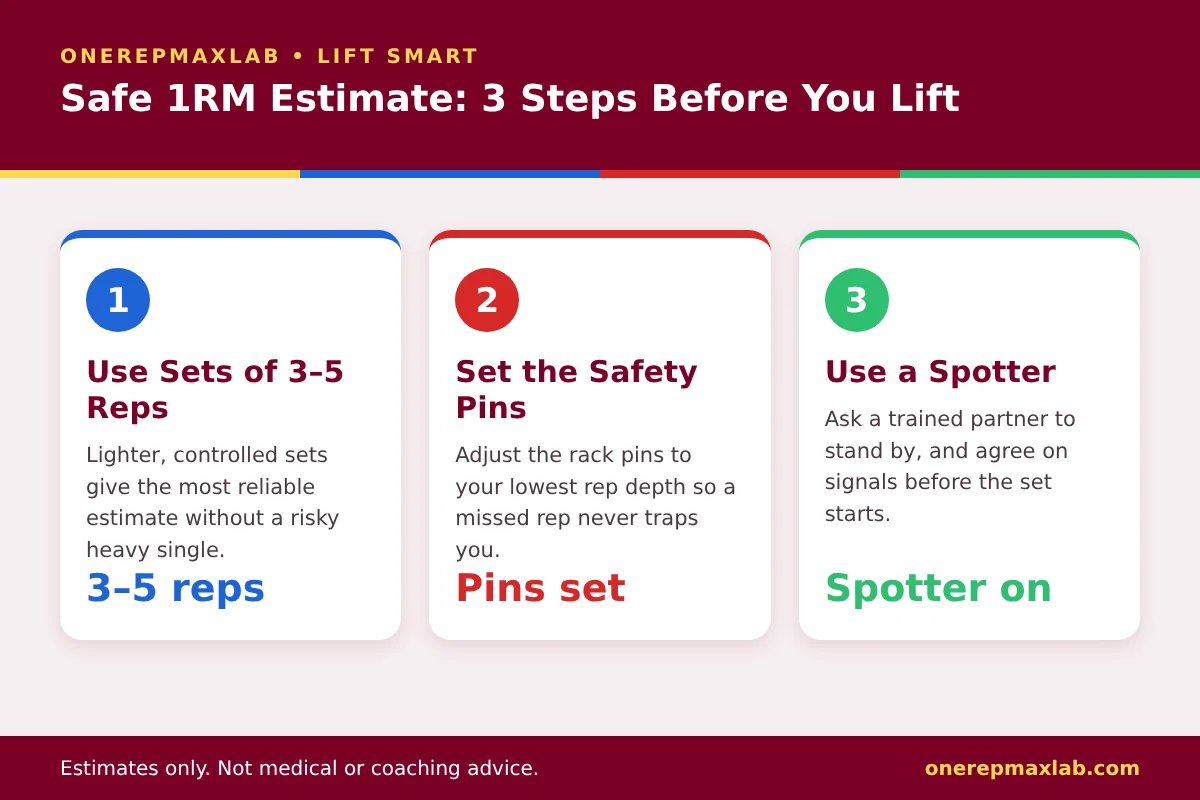
Heavy lifting carries real risk. Strength training builds resilience, but near-maximal and maximal attempts put more stress on muscles, joints, and connective tissue than everyday training does. To reduce that risk, we recommend:
For deeper guidance on safe training, read the NSCA safety and training guidelines, which cover professional standards and safe return to training.
- A thorough, progressive warm-up before working sets
- Qualified coaching if you are new to barbell lifts
- A power rack with safety pins or safety arms
- Collars on the bar and a competent spotter for heavy attempts
- Stopping any lift that feels unsafe or painful
Everyone responds differently to training. Age, training history, genetics, sleep, nutrition, stress, and recovery all shape what you can safely lift. A benchmark or calculated number on this site is a reference point, not a promise or a target built for you.
Understanding Your 1RM Estimate
Your result is a prediction, not a measurement. Our calculator uses published equations to estimate the heaviest weight you could lift for a single repetition. These include Epley, Brzycki, Lander, Lombardi, Mayhew, O’Conner, and Wathan. The calculator never observes your actual lift, so its output is a mathematical projection from the weight and reps you enter.
Why estimates drift. Your true one rep max moves with your technique, fatigue, equipment, time of day, and the way you were tested. Each formula was also built on its own group of lifters under specific conditions, so none works equally well for every exercise, experience level, or rep range.
How to get the most reliable number:
- Use lower rep sets. Sets of roughly 3 to 5 reps give the most dependable estimates. Past about 10 reps, muscular endurance starts to distort the result.
- Compare several formulas. The spread between results works better as a realistic range than any single figure.
- Use it for planning, not proof. The calculator suits programming, percentage-based training, and tracking progress. If you need a verified max for competition or formal assessment, use a supervised testing session with a proper protocol.
About Our Content
Our articles and guides draw on recognized sports science sources, coaching frameworks, and practical lifting experience. We work to keep them accurate and clear, but exercise science keeps evolving. A page may not reflect the newest research, and we cannot promise every piece of content is complete, current, or error-free. Content is offered “as is” for general education. Cross-check important training decisions with a qualified coach or current literature.
Spotted a mistake? Tell us. We take corrections seriously.
Links, Ads, and Affiliates
External websites. We may link to outside resources such as reference databases, strength standard tools, and professional organizations. These links are a convenience. We don’t control those sites and aren’t responsible for their content, accuracy, availability, or privacy practices. Once you click through, their policies apply.
Advertising. onerepmaxlab.com may show ads served by third-party advertising networks. Advertisers and ad networks control those ads, and we don’t create, review, or endorse them. An ad appearing here is not a recommendation from us.
Affiliate links. Some links may be affiliate links, meaning we may earn a small commission if you buy through them, at no extra cost to you. This never shapes our editorial content, calculator logic, or strength standards. We recommend things because they are relevant and useful, not because of a commercial relationship.
Disclaimer OneRepMaxLab: Limitation of Liability
To the fullest extent permitted by law, onerepmaxlab.com and its owner are not liable for any direct, indirect, incidental, or consequential loss or damage arising from your use of this site. That includes physical injury from applying training information, decisions made from calculator estimates, and reliance on third-party content we link to.
By using this site, you accept responsibility for your own training choices and safety.
Contact
Questions about this disclaimer, or a correction to report? Reach us through our contact page or email us at support@onerepmaxlab.com.