One Rep Max Calculator (1RM) Train Smarter
Short answer: A one rep max calculator estimates the heaviest weight you could lift once from a single hard set of reps, so you can set training loads without a risky max attempt.
Every lifter has chased a true single at least once: ego running hot, a spotter watching nervously, a bar that decides whether the day ends well. A one rep max calculator offers a calmer route. Feed it the weight and reps from one hard, clean set and it returns an estimated max you can program from, with no maximal attempt required.
Wondering whats my 1 rep max, or how to work out one rep max without risking a heavy single? Enter the weight and reps from a recent hard set and you can calculate your 1 rep max in seconds. The tool runs in your browser, so it works like a one rep max calculator app on your phone, tablet or laptop, with nothing to download.
Your one-repetition maximum (1RM) is the heaviest weight you can lift for one complete repetition with proper form. Treat it as a snapshot of maximal strength, not a permanent badge. Training percentages are built on it, so guessing quietly wastes months of honest effort, while a reliable estimate lets you progress deliberately from week to week.
Epley, Brzycki and the other equations are only as honest as the set you feed them. A bounced bench press, shallow squat depth or a hitched deadlift turns a messy set into fiction, which is why this guide compares multiple formulas and watches the spread between them.
What Is One Rep Max? The 1-Repetition Maximum (1RM) Explained
Short answer: Your one rep max (1RM) is the heaviest weight you can lift for one complete repetition with proper form. An estimated 1RM (E1RM) is calculated from a submaximal set instead of being lifted.
A one rep max is the heaviest weight you can move for a single repetition on a given exercise, with proper technique intact. Lifters shorten it to 1RM, and coaches lean on it because a true max shows maximal strength in one clean number. In powerlifting it is the gold-standard measure of absolute strength. Across general strength training it works more like a compass: a useful number to train from, not a trophy.
1RM, 1Max Rep and E1RM: Same Idea, Different Labels
You will see the same idea written several ways: 1RM, one-rep max, one-repetition maximum, 1Max Rep and rep max. The label that matters most is E1RM (estimated 1RM): a calculated value predicted from a submaximal set rather than a weight you actually lifted. In this guide, “1RM” means a tested single and “E1RM” or “estimated max” means a calculated one.
What Changes Your 1RM
Your number is not fixed. Neural adaptations, lean muscle mass, diet, sleep and recovery capacity all move it, which is why an estimate from three months ago can mislead you today. Re-estimate every 4 to 6 weeks.
1RM vs Rep Max
Short answer: A 1RM is the most you can lift once. A rep max (such as a 5RM) is the most you can control for a set number of reps, and it is not a ceiling: 8 reps at 120 kg implies a 1RM near 152 kg by the Epley formula.
A 1RM is the maximum load you can move once with proper form. A rep max (for example a 5RM) is the heaviest load you can control for a chosen number of reps before technique fades. The classic mistake is treating a rep max as a ceiling: grinding out eight reps with 120 kg on bench press shows an eight-rep max, and by the Epley formula it implies a 1RM near 152 kg, not 120 kg.
| Metric | Definition | Example | Best use |
|---|---|---|---|
| 1RM | Heaviest load lifted once with proper form | Squat single at 150 kg | Anchor for percentage-based programs |
| Rep max (e.g. 5RM) | Heaviest load controlled for a set number of reps | Bench 120 kg for 8 reps (8RM) | Tracking repeatable strength |
| E1RM | 1RM calculated from a submaximal set | 100 kg x 5 gives about 116.6 kg (median) | Programming without maxing out |
A submax set earns its keep. Enter the weight from a recent set taken close to failure with clean form, and the rep max calculator estimates your 1RM instantly, even if you never chase a heavy single. The rep max shows what you can repeat; the 1RM is the reliable training anchor.
Why Your 1RM Matters for Programming
Without a number to anchor your loads, every session depends on how the bar feels that day. A 1RM, tested or estimated, gives you and your coach a shared reference point, so each set has a purpose instead of a hunch. Training percentages hang directly off it.
Training Percentages at a Glance
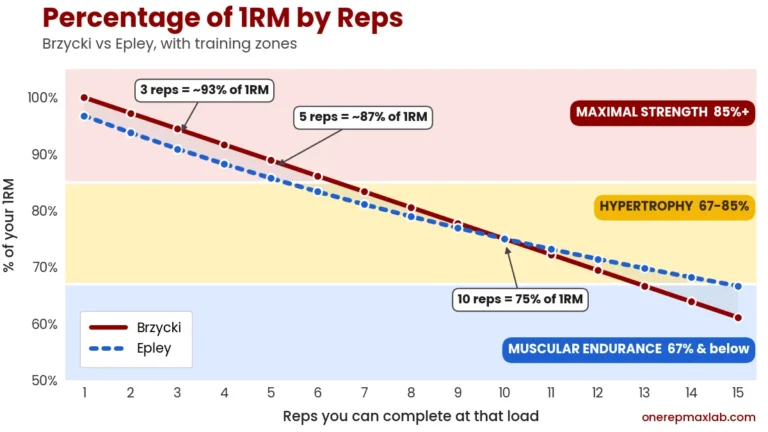
Short answer: Maximal strength work sits at 85% of 1RM and above (6 reps or fewer), hypertrophy at about 67 to 85% (6 to 12 reps), and muscular endurance at 67% and below (12 or more reps).
| Training goal | % of 1RM | Typical reps per set |
|---|---|---|
| Maximal strength | 85% and above | 6 or fewer |
| Power (single-effort) | 80 to 90% | 1 to 2 |
| Hypertrophy | 67 to 85% (many programs sit near 70 to 80%) | 6 to 12 |
| Muscular endurance | 67% and below | 12 or more |
Commonly cited ranges (Haff & Triplett, 2016). They are guidelines, not rules, and individual response varies.
How Many Reps Equal What Percentage of 1RM?
The two most common conversions, Brzycki and Epley, translate reps at a given load into a percentage of your 1RM. They agree closely through the middle of the range and drift apart as reps climb.
| Reps | Brzycki | Epley | Average |
|---|---|---|---|
| 1 | 100.0% | 96.8% | 98.4% |
| 2 | 97.2% | 93.8% | 95.5% |
| 3 | 94.4% | 90.9% | 92.7% |
| 4 | 91.7% | 88.2% | 90.0% |
| 5 | 88.9% | 85.7% | 87.3% |
| 6 | 86.1% | 83.3% | 84.7% |
| 8 | 80.6% | 78.9% | 79.8% |
| 10 | 75.0% | 75.0% | 75.0% |
| 12 | 69.4% | 71.4% | 70.4% |
At 1 rep, use 100% by definition. Percentages are estimates, not guarantees.
3 Rep Max to 1 Rep Max: Quick Conversion
To go from a 3 rep max to 1 rep max, multiply the weight by the formula's 3-rep factor. For a 100 kg triple, the seven formulas in this guide return 105.9 to 114.0 kg, with a median of 109.0 kg. Epley gives 110.0 kg and Brzycki gives 105.9 kg. Use the median as your working estimate, and see the comparison table below for 5, 8 and 10 reps.
A Worked Example: From 100 kg x 5 to Working Weights
Say you bench 100 kg for a hard, clean set of five. The seven formulas in this guide return estimates from 112.5 to 119.0 kg. The median is 116.6 kg and the average is 115.5 kg. Using the median as the working E1RM and rounding to the nearest 2.5 kg gives these working weights:
| % of E1RM | Exact load | Rounded to plates |
|---|---|---|
| 65% | 75.8 kg | 75.0 kg |
| 70% | 81.6 kg | 82.5 kg |
| 75% | 87.4 kg | 87.5 kg |
| 80% | 93.3 kg | 92.5 kg |
| 85% | 99.1 kg | 100.0 kg |
| 90% | 104.9 kg | 105.0 kg |
| 95% | 110.8 kg | 110.0 kg |
Strength Blocks, Hypertrophy Work and Peaking
Short answer: Good programs move through strength, hypertrophy and endurance phases, then peak. Loads tied to a known 1RM show whether your progress is real.
Good programs move through phases: strength blocks at higher percentages, hypertrophy work at moderate percentages, muscular endurance lower still, then peaking before a meet or retest. Without loads tied to a known number you cannot tell whether progress is real or just a lucky, mentally fresh Tuesday.
Apply progressive overload through small, planned increases in load, reps or sets, and let a re-estimated 1RM rather than ego decide when to move up. Build deload weeks into every cycle: chronic overtraining and burnout creep in when sets run too heavy for too long, and tendons and connective tissue recover more slowly than muscle.
Are One-Rep Max Calculators Accurate?
Short answer: Yes, accurate enough to program from when the set is hard, clean and 3 to 10 reps (4 to 8 is the sweet spot). Accuracy drops with sloppy form and higher rep counts.
Yes, with conditions. A one rep max calculator gives an estimate, and a good estimate is accurate enough to program from when the input set is hard, clean and in a sensible rep range. Studies that compare prediction equations (for example LeSuer et al., 1997; and Reynolds et al., 2006) generally report that no single equation is best for every lift, load and lifter, and that prediction error tends to grow as repetitions increase.
Sloppy reps invalidate the estimate. Once form breaks down, momentum quietly inflates the number. Run two or three formulas, or all of them, and check whether the results cluster closely: a tight cluster earns trust, a wide one is a warning.
Best Rep Ranges for Reliable Estimates
Use sets of 3 to 10 reps, with 4 to 8 as the sweet spot. Below three reps the load is already close to your max, so the formula adds little and the set is fatiguing for little gain. Above ten, burn tolerance, pacing and endurance muddy the picture and estimates drift, so avoid 12 to 20 rep marathons when estimating a max.
A real single should be logged as lifted, not calculated. At one rep several equations return more than the weight on the bar (Mayhew by nearly 9%), which is another reason to enter your actual single directly.
What Changes Accuracy
- Technique: bouncing the bar, cutting range of motion or hitching a deadlift flatters the result.
- Fatigue and recovery: poor sleep, stress, short rest and accumulated fatigue from a heavy training week all drag estimates around.
- Effort: a set stopped far from failure underestimates your max. Track RPE or reps in reserve so effort is consistent.
- Rep count: 3 to 10 reps near-maximal effort gives cleaner data than high reps taken to failure.
- Consistency: same lift setup, same formula and same protocol every time.
How to Calculate One Rep Max Safely: Testing vs Estimating
Short answer: For most lifters, estimate your max from one hard set of 3 to 10 reps instead of testing a true single. It carries less injury risk, and you can repeat it every 4 to 6 weeks.
There are two routes to a 1RM: test a true max, or estimate it from a submaximal set. Both can work. They carry very different risks.
Traditional Maximum Testing
A traditional test works up to a single through progressively heavier attempts. It gives a definitive number for that day, which suits competition prep and peaking, but it exposes joints, tendons and connective tissue to extreme mechanical stress. One failed lift can disrupt weeks of training, and fatigue from repeated attempts makes each later one feel worse.
Only test when you are well rested, properly fueled and mentally prepared, with a progressive warm-up, an experienced spotter and a rack with safeties. Chasing a true 1RM without safety equipment or a qualified spotter invites significant risk, and it is a poor idea for complete beginners.
Submaximal Testing: The Safer, Smarter Approach
Submaximal testing estimates your max from a hard set of 3 to 10 reps instead of a single. It lowers joint stress, removes the mental barrier of heavy singles, allows better form and works for almost any movement, including a front squat. For most lifters, and especially intermediates who feel anxious under heavy bars, it is the better default.
How to Determine 1 Rep Max Step-by-Step (Without Maxing Out)
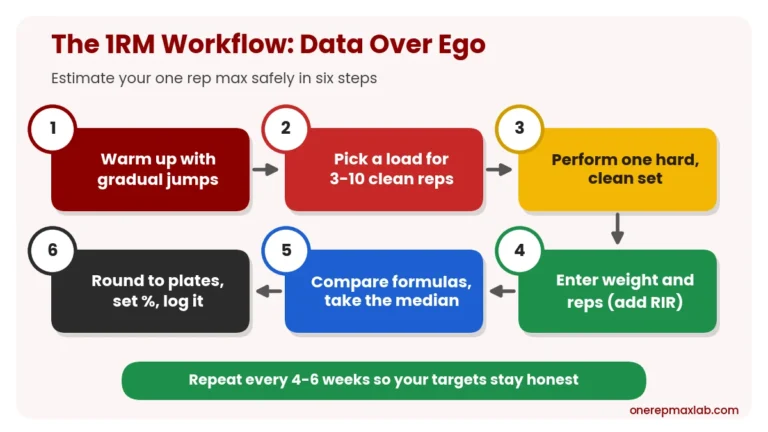
- Warm up with gradual jumps until the bar feels light and your technique is sharp.
- Choose a load you can lift for 3 to 10 clean reps (aim for 4 to 8).
- Perform one hard set with consistent form and full range of motion. Stop before form collapses, and stop immediately at sharp pain.
- Record the weight and the reps completed. If you stopped with reps in reserve, add them (see the RPE table below).
- Enter both numbers in the calculator, compare the formulas and take the median.
- Round to usable plates, set your training percentages and log the estimate. Repeat in 4 to 6 weeks.
Using RPE and Reps in Reserve (RIR)
Rating of perceived exertion (RPE) and reps in reserve (RIR) tell the calculator how close to failure the set really was. If you finished with reps left in the tank, add them to the reps you completed before you enter the number.
| RPE | Reps in reserve | What it means | Reps to enter (if you completed 5) |
|---|---|---|---|
| 10 | 0 | No more reps possible | 5 |
| 9 | 1 | One more rep was possible | 6 |
| 8 | 2 | Two more reps were possible | 7 |
| 7 | 3 | Three more reps were possible | 8 |
RIR judgments tend to be more accurate for experienced lifters and for sets closer to failure (Zourdos et al., 2016), so treat RPE 7 estimates as the roughest.
Traditional vs Submaximal 1RM Testing
| Factor | Traditional max test | Submaximal estimate |
|---|---|---|
| Result | Definitive number for that day | Estimate that depends on set quality and formula |
| Injury risk | Higher: extreme loads | Lower: moderate loads |
| Equipment | Spotter, safeties and a progressive warm-up | Good technique; spotter or safeties still sensible |
| Mental demand | High | Lower |
| Recovery cost | High; can disrupt training | Low |
| How often | Rarely, when there is a reason | Every 4 to 6 weeks |
| Best for | Competition prep and peaking | Most lifters, including intermediates |
What You'll Need: Weight, Reps and Your Lift Choice
Before touching the calculator, gather three things:
- Weight on the bar: the total load. For weighted dips or pull-ups, count bodyweight plus added weight. For dumbbells, decide whether you enter per-dumbbell or total load and never mix the two or double a number by mistake.
- Reps completed: count only clean reps from a hard set. Consistent reps beat plain guesswork.
- Lift choice: squat, deadlift, bench press, overhead press, front squat or dumbbell bench. Pick one repeatable setup so each estimate reflects the same movement.
How to Use the One Rep Max Calculator
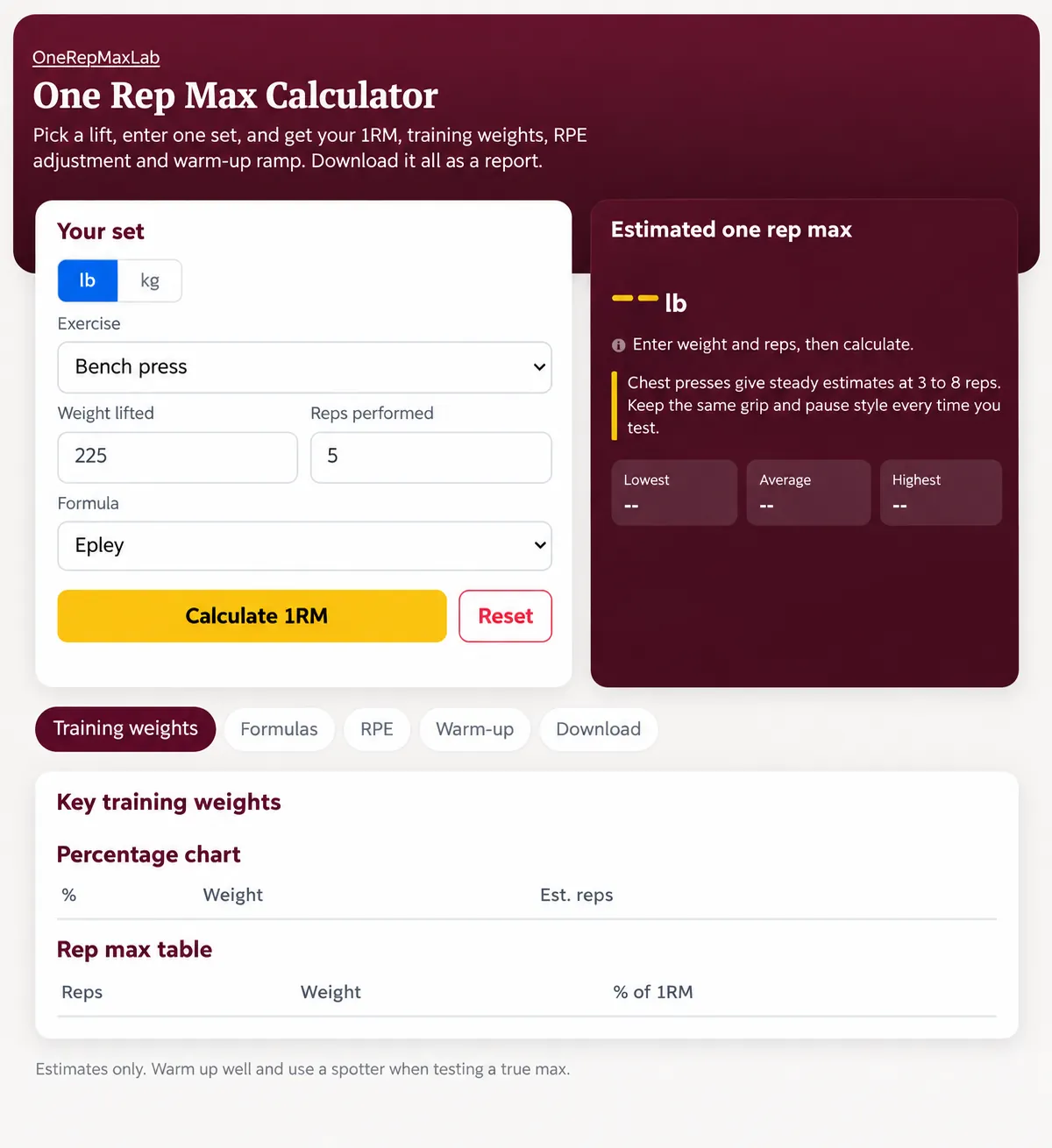
This is the opening screen. The maroon header carries the title. Under it are two cards: your input form on the left and the result panel on the right, which shows dashes until you calculate. Five tabs sit below them: Training weights, Formulas, RPE, Warm-up and Download.
How to use it:
- Unit Selection: Choose lb or kg with the toggle at the top of the form. The active unit turns blue.
- Results: The small dot in the result panel is grey while it waits. It turns glowing green once a result is ready.
- Suggestions: The yellow line under the result title is a short tip for the exercise you picked.
Calculate my one rep max: getting your estimated 1RM
- Pick your exercise: Type the weight you lifted and the reps you completed.
- Press Calculate 1RM: The result also updates while you type.
- Use a hard set of 2 to 10 reps. Very high reps make every formula less accurate.
- A narrow gap: Between Lowest and Highest means the estimate is more dependable.
Comparing all seven formulas
Formulas disagree slightly, so this tab lists all seven side by side: Epley, Brzycki, Lombardi, Mayhew, McGlothin, O’Conner and Wathan, plus their average. The row for your chosen formula is highlighted in blue and the average bar glows green.
How to use it:
- Change the Formula menu in the form to rebuild every table with a different formula.
- Choose “Average of all” if you do not want to depend on one formula.
- Use the bars to see at a glance which formulas read higher or lower.
The shareable image card
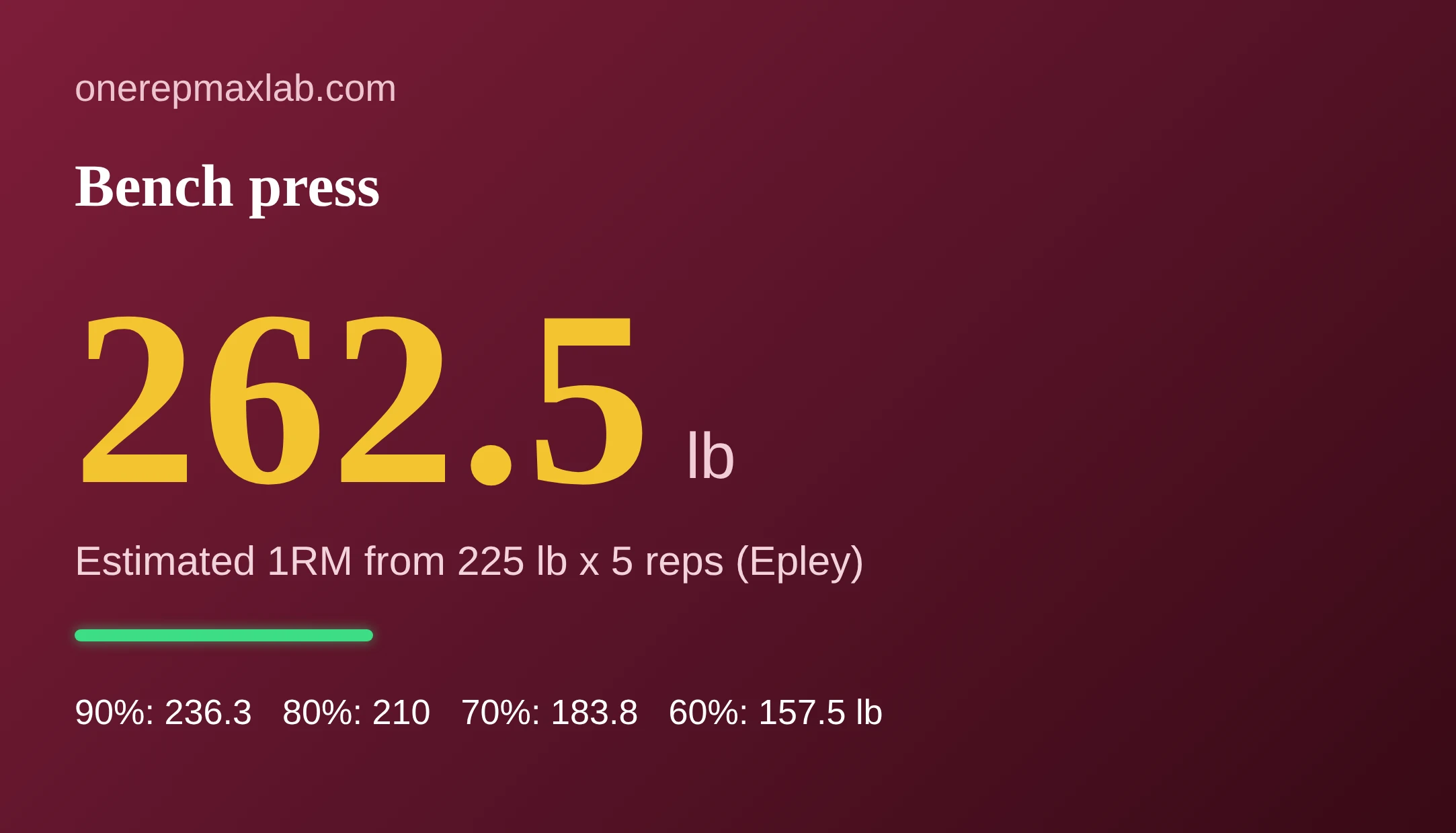
The Image card button creates a PNG with your exercise, your estimated 1RM in large yellow type, the set it came from and four common training weights.
How to use it:
- Save it to your phone to compare with your next test.
- No download needed: the page works like a one rep max calculator app on any phone browser.
- Convenient for sharing with others.
- Create a new one after each calculation to keep a simple progress record.
The Formulas Inside This One Rep Max Calculator
Short answer: The calculator runs seven equations side by side: Epley, Brzycki, Lombardi, O’Conner, Wathan, Mayhew and Lander (McGlothin shares Lander’s coefficients). For 100 kg × 5 they return 112.5 to 119.0 kg.
This calculator runs seven published equations side by side so you can see where they agree and where they diverge: Epley, Brzycki, Lombardi, O’Conner, Wathan (often spelled Wathen), Mayhew and Lander. The McGlothin equation appears in common formula lists with the same coefficients as Lander’s, so it is covered under that name. In every formula, w is the weight lifted, r is the reps completed and e is Euler’s number.
1RM Formula Overview (100 kg × 5 reps)
| Formula | Equation | 100 kg × 5 | Behavior |
|---|---|---|---|
| Epley | 1RM = w × (1 + r / 30) | 116.7 kg | Linear; steady climb |
| Brzycki | 1RM = w × 36 / (37 − r) | 112.5 kg | Curved; steepens at high reps, undefined at 37 |
| Lombardi | 1RM = w × r0.10 | 117.5 kg | Power curve; flattens at high reps |
| O’Conner | 1RM = w × (1 + 0.025 × r) | 112.5 kg | Linear; lowest slope, so conservative |
| Wathan (Wathen) | 1RM = 100w / (48.8 + 53.8 × e−0.075r) | 116.6 kg | Exponential curve fit |
| Mayhew | 1RM = 100w / (52.2 + 41.9 × e−0.055r) | 119.0 kg | Exponential curve fit; highest at 5 reps |
| Lander (McGlothin) | 1RM = 100w / (101.3 − 2.67123 × r) | 113.7 kg | Rises faster at higher reps |
w = weight lifted, r = repetitions. Bars are scaled to the highest result (Mayhew, 119.0 kg).
Compare Every 1RM Formula
Short answer: For a 100 kg set of 5 the median estimate is 116.6 kg and the average is 115.5 kg. Use the median, or the average if you do not want to depend on one formula.
Comparison Table: Epley, Brzycki, Lombardi, McGlothin and More
Same lift, same weight, different formulas. Each cell shows the estimated 1RM in kg for a 100 kg set (McGlothin matches the Lander column).
| Formula | 3 reps | 5 reps | 8 reps | 10 reps |
|---|---|---|---|---|
| Epley | 110.0 | 116.7 | 126.7 | 133.3 |
| Brzycki | 105.9 | 112.5 | 124.1 | 133.3 |
| Lombardi | 111.6 | 117.5 | 123.1 | 125.9 |
| O’Conner | 107.5 | 112.5 | 120.0 | 125.0 |
| Wathan | 109.0 | 116.6 | 127.7 | 134.7 |
| Mayhew | 114.0 | 119.0 | 126.3 | 130.9 |
| Lander | 107.2 | 113.7 | 125.1 | 134.1 |
| Median | 109.0 | 116.6 | 125.1 | 133.3 |
| Average | 109.3 | 115.5 | 124.7 | 131.0 |
All values in kg. Results are estimates of one-rep max for a 100 kg lift at each rep count.
Which Formula Should You Choose?
No single formula suits every lifter, and being widely cited in research does not make one universally right. Treat all seven as tools and match your approach to the set you did.
| Your situation | Suggested approach |
|---|---|
| Heavy sets of 3 to 5 reps | Take the median, and use Brzycki and Epley as a sanity check; they land within about 4% of each other here |
| Moderate sets of 6 to 10 reps | Run all formulas side by side and use the median |
| Beginner, returning from a layoff, or unsure of your form | Lean toward the lower end of the spread |
| Sets above 10 reps | Repeat with a heavier load; the formulas disagree too much to trust |
| Competition prep or peaking | Do not rely on an estimate alone; schedule a supervised test |
Practical Application Tips: Bench Press, Squat, Deadlift and Overhead Press
Short answer: Keep technique identical every time (same depth, touch point, stance and lockout), and use 3 to 8 reps for most lifts and 3 to 6 for deadlifts.
An estimate is only as repeatable as the lift behind it. Fix these details first so changes in your number reflect strength, not technique drift.
| Lift | Standardize | What inflates the estimate | Rep guidance |
|---|---|---|---|
| Bench press | Touch point, bar path, foot and shoulder position, full lockout | Bouncing off the chest, uneven lockout | 3 to 8; use safeties or a spotter |
| Squat | Depth, stance, bar position | Shallow depth, bouncing out of the hole | 3 to 8; use safeties |
| Deadlift | Stance, grip, dead stop each rep | Hitching, touch-and-go bounce, rounding | 3 to 6 is common as fatigue builds quickly |
| Overhead press | Strict stance, full lockout overhead | Leg drive, leaning back | 3 to 8 |
| Dips, dumbbell and front squat | Total load method (bodyweight plus added, per-dumbbell or total) | Mixing load methods between sessions | 4 to 8 |
One Rep Max Deadlift Calculator: Estimate Your Deadlift 1RM
Use this page as a deadlift one rep max calculator: choose Deadlift in the exercise menu, enter the weight and reps from a hard set of 3 to 6, and you get your estimated max. It works as a one rep max calculator for deadlift whether you pull conventional or sumo. Keep the same stance and use a dead stop on every rep, because touch-and-go bounce and hitching inflate the result.
Squat One Max Rep Calculator
For squats, pick Squat in the same exercise menu. This one max rep calculator squat option uses the same seven formulas, so keep depth, stance and bar position consistent from test to test and your estimates stay comparable.
Applying 1RM Conversions Safely
Short answer: Treat every estimate as today’s best guess: log a recent set taken close to failure, warm up, round to your plates, and retest every 4 to 6 weeks with the same formula.
Treat every estimated 1RM as today’s best guess, never gospel.
Log the Right Set
Log reps from a recent set taken close to failure with tight form, and recalculate whenever performance drops. Reduce the percentage after any shaky rep, because managing fatigue beats pride.
Warm Up, Round and Switch Units
Warm up with gradual jumps before you hit work sets near 70% of your estimate. Apply plate-friendly rounding to the nearest 0.5, 1 or 2.5 kg, or 1, 2.5 or 5 lb, depending on the plates you own. Before you switch units, confirm that every number updates together (1 kg is about 2.2046 lb).
Track Trends, Not Single Days
Retest every 4 to 6 weeks, keep the same formula and the same protocol so comparisons stay valid, and note sleep, recovery and rest alongside each estimate. Save heavier singles for days you feel ready, and never rush rest between attempts.