Quick answer: A lift is only "strong" relative to the lifter's bodyweight and sex. The Strength Standards Calculator compares a one-rep max (actual or estimated) for the back squat, bench press, deadlift, overhead press or barbell row against bodyweight-multiple benchmarks. It returns one of six levels (Getting Started, Beginner, Novice, Intermediate, Advanced or Elite) and the exact weight needed to reach the next one.
Absolute load is misleading on its own. A 300 lb bench press means something different for a 150 lb lifter than for a 250 lb lifter. Dividing the lift by bodyweight removes much of that distortion and gives a fairer basis for comparing lifters, exercises and training blocks.
The Strength Standards Calculator works in pounds or kilograms, applies separate male and female standards, and runs in four modes: rating a single lift, scoring several lifts together, checking balance between lifts, and listing target weights for every level at a given bodyweight. Results can be saved as an image, PDF or CSV file.
What the Strength Standards Calculator Does
The Strength Standards Calculator turns a set (or a known one-rep max) into a strength level, a score and a next target, using bodyweight multiples for the selected sex. A "What do you want to calculate?" menu switches between four modes, and every mode reports in pounds or kilograms.
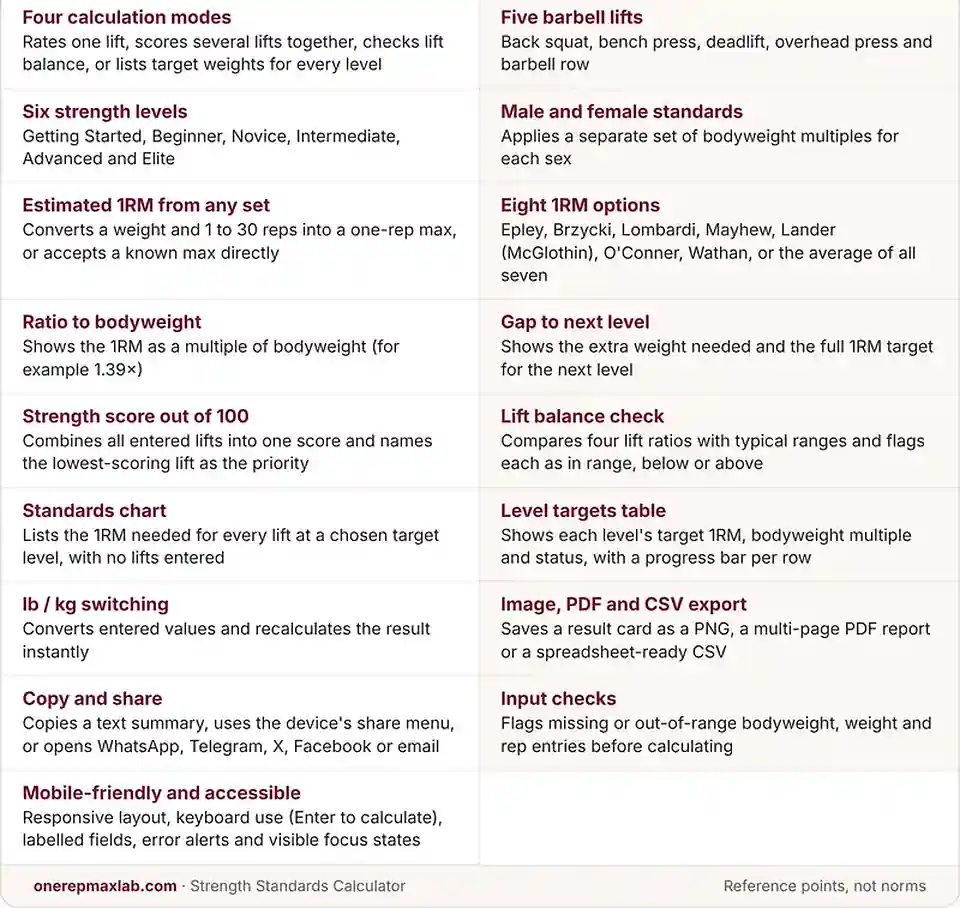
View Table 1 as text
| Feature | What It Does |
|---|---|
| Four calculation modes | Rates one lift, scores several lifts together, checks lift balance, or lists target weights for every level |
| Five barbell lifts | Back squat, bench press, deadlift, overhead press and barbell row |
| Six strength levels | Getting Started, Beginner, Novice, Intermediate, Advanced and Elite |
| Male and female standards | Applies a separate set of bodyweight multiples for each sex |
| Estimated 1RM from any set | Converts a weight and 1 to 30 reps into a one-rep max, or accepts a known max directly |
| Eight 1RM options | Epley, Brzycki, Lombardi, Mayhew, Lander (McGlothin), O'Conner, Wathan, or the average of all seven |
| Ratio to bodyweight | Shows the 1RM as a multiple of bodyweight (for example 1.39×) |
| Gap to next level | Shows the extra weight needed and the full 1RM target for the next level |
| Strength score out of 100 | Combines all entered lifts into one score and names the lowest-scoring lift as the priority |
| Lift balance check | Compares four lift ratios with typical ranges and flags each as in range, below or above |
| Standards chart | Lists the 1RM needed for every lift at a chosen target level, with no lifts entered |
| Level targets table | Shows each level's target 1RM, bodyweight multiple and status, with a progress bar per row |
| lb / kg switching | Converts entered values and recalculates the result instantly |
| Image, PDF and CSV export | Saves a result card as a PNG, a multi-page PDF report or a spreadsheet-ready CSV |
| Copy and share | Copies a text summary, uses the device's share menu, or opens WhatsApp, Telegram, X, Facebook or email |
| Input checks | Flags missing or out-of-range bodyweight, weight and rep entries before calculating |
| Mobile-friendly and accessible | Responsive layout, keyboard use (Enter to calculate), labelled fields, error alerts and visible focus states |
Strength Level (One Lift)
This mode rates a single exercise. After choosing the lift, entering the weight lifted and the reps performed, the Strength Standards Calculator estimates a 1RM with the selected formula. Ticking "This is my one rep max" skips the reps field. The result shows the level, the estimated 1RM, the ratio to bodyweight and the next target. Sets above 10 reps trigger a note that the estimate is less reliable.
Overall Strength Score
This mode accepts any combination of the five lifts. Each lift is rated on its own, and the overall level is the average of those ratings rounded to the nearest level. The score runs from 0 to 100, with each level occupying a 20-point band. Elite starts at 100. When more than one lift is entered, the lift with the lowest score is named as the priority lift.
Symmetry and Lift Balance
This mode compares pairs of lifts against rule-of-thumb ratios. Both lifts in a pair must be entered for that check to appear.
| Comparison | Typical Range |
|---|---|
| Bench press ÷ back squat | 0.65 – 0.85 |
| Back squat ÷ deadlift | 0.75 – 0.95 |
| Overhead press ÷ bench press | 0.55 – 0.75 |
| Barbell row ÷ bench press | 0.80 – 1.05 |
The headline shows how many ratios sit in range, and the tip names the first ratio outside its range and which lift may be lagging.
Standards Chart
This mode needs only bodyweight and sex. A "Target level" menu (Beginner to Elite) lists the 1RM required for each of the five lifts. The detail table underneath shows every level for every lift.
Result Card, Exports and Sharing
Every result appears in a summary card with a headline, three key figures and a short tip, followed by detail tables. The image export creates a 1080 × 630 px card, the PDF is generated in the browser as an A4 report, and the CSV contains the same tables. Reset clears all inputs and results.
How to Use the Strength Standards Calculator
Quick answer: Using the Strength Standards Calculator takes six steps and under a minute. Only bodyweight and one lift are needed for a first result.
- Choose what to calculate. Pick Strength level, Overall strength score, Symmetry and lift balance, or Standards chart.
- Set the profile. Select Male or Female standards and lb or kg.
- Enter bodyweight. The accepted range is 55 to 882 lb or 25 to 400 kg.
- Enter the lift. For a single lift, choose the exercise, then enter the weight and reps, or tick "This is my one rep max." For score and balance modes, fill in weight and reps for each lift and leave unused lifts blank. For the standards chart, choose a target level instead.
- Choose a formula. The default is Epley. Brzycki, Lombardi, Mayhew, Lander (McGlothin), O'Conner, Wathan and an average of all formulas are also available.
- Press Calculate. Changing the sex, unit, exercise, formula or target level afterwards updates the result without another click.
One Rep Max Calculator and Strength Level in One Step
Do not know your max yet? Work it out with the one rep max calculator first, then bring the number here to see your strength level. You can also skip that step: enter the weight and reps from a hard set and this tool estimates the 1RM and rates it against your bodyweight automatically.
Tips for the Most Accurate Comparison
- Use a clean, technically consistent set rather than a one-off PR attempt.
- Keep the set at 10 reps or fewer, as longer sets make any 1RM estimate less reliable.
- Enter a tested max with 1 rep when one is available.
- Re-run the Strength Standards Calculator when bodyweight changes significantly, since every target scales with it.
- Treat the level as context for training decisions rather than a final verdict, and compare it with training history.
What Are Strength Standards? The Six Levels Explained
Quick answer: Strength standards are benchmarks that place a lift in context using bodyweight, sex and training history. The Strength Standards Calculator uses six levels, and each one is linked to a bodyweight multiple for the selected lift and sex.
A heavier lifter and a lighter lifter cannot be compared on one universal number, so standards normalise the comparison. Coaches, athletes and everyday lifters can then use the same language, while still allowing for the effect of leverages and body composition on any single result.
The Six Strength Levels
| Level | What It Means | Typical Training History |
|---|---|---|
| Getting Started | Below the Beginner multiple for that lift | Little or no experience with the movement |
| Beginner | Can perform the lift correctly but is early in training | New to the exercise |
| Novice | Has trained the lift regularly for some time | Up to several months of regular training |
| Intermediate | Has trained consistently for a longer period | Up to a couple of years of regular training |
| Advanced | Has progressed through multiple years of training | Multiple years |
| Elite | Competes in strength sports | Years of competitive-focused training |
The training-history descriptions follow the level definitions published by ExRx.net, whose standards come from Dr. Lon Kilgore. ExRx uses "Untrained" for the entry tier that this calculator calls Beginner. Training history is only a guide: a lifter's level can differ from lift to lift, and the multiples set the rating, not the calendar.
Training Age in Exercise Science
Research groups lifters by training status because the best way to program training changes as experience grows. The American College of Sports Medicine (ACSM) position stand defines three groups and recommends a different weekly frequency for each.
| Training Status | ACSM Definition | Recommended Frequency |
|---|---|---|
| Novice | Untrained, with no resistance-training experience or none for several years | 2–3 days per week |
| Intermediate | About 6 months of consistent resistance training | 3–4 days per week |
| Advanced | Years of resistance-training experience | 4–5 days per week |
Source: ACSM Position Stand, Progression Models in Resistance Training for Healthy Adults, Medicine & Science in Sports & Exercise, 2009. Earlier work by Kraemer and Ratamess (2004) set out how progression and exercise prescription should be adjusted to training status.
These categories describe how someone should train. They do not rate how strong someone is, which is why standards tables add bodyweight and sex.
Multiples vs. Percentile Standards
This Strength Standards Calculator rates lifts against fixed bodyweight multiples. Other databases rank lifts against a population instead. Strength Level, for example, defines Beginner, Novice, Intermediate, Advanced and Elite as stronger than 5%, 20%, 50%, 80% and 95% of the lifters in its community data. Its reference group is people who log their lifts, not the general public, so the two approaches can give different thresholds for the same lifter.
Strength Standards by Bodyweight: 1RM Benchmarks
Quick answer: Multiply bodyweight by the multiple for a lift, sex and level to get the one-rep max needed. The highest level a lift meets or exceeds is the current level, and the next column is the target. A 180 lb man needs a 270 lb squat for Intermediate (1.5×), and a 130 lb woman needs a 130 lb squat (1.0×).
Bodyweight Multiples Used by the Strength Standards Calculator
The tables list the one-rep max, as a multiple of bodyweight, required to reach each level. A lift below the Beginner multiple is rated Getting Started.
Male Standards
| Lift | Beginner | Novice | Intermediate | Advanced | Elite |
|---|---|---|---|---|---|
| Back squat | 1.00× | 1.25× | 1.50× | 1.75× | 2.25× |
| Bench press | 0.75× | 1.00× | 1.25× | 1.50× | 1.75× |
| Deadlift | 1.00× | 1.50× | 1.75× | 2.25× | 2.75× |
| Overhead press | 0.50× | 0.65× | 0.80× | 1.00× | 1.25× |
| Barbell row | 0.65× | 0.85× | 1.05× | 1.25× | 1.50× |
Female Standards
| Lift | Beginner | Novice | Intermediate | Advanced | Elite |
|---|---|---|---|---|---|
| Back squat | 0.50× | 0.75× | 1.00× | 1.25× | 1.50× |
| Bench press | 0.35× | 0.50× | 0.65× | 0.85× | 1.00× |
| Deadlift | 0.60× | 0.90× | 1.15× | 1.40× | 1.75× |
| Overhead press | 0.25× | 0.40× | 0.55× | 0.70× | 0.85× |
| Barbell row | 0.40× | 0.55× | 0.75× | 0.95× | 1.15× |
Male Strength Standards at 180 lb Bodyweight
| Lift (1RM, lb) | Beginner | Novice | Intermediate | Advanced | Elite |
|---|---|---|---|---|---|
| Back squat | 180 | 225 | 270 | 315 | 405 |
| Bench press | 135 | 180 | 225 | 270 | 315 |
| Deadlift | 180 | 270 | 315 | 405 | 495 |
| Overhead press | 90 | 117 | 144 | 180 | 225 |
| Barbell row | 117 | 153 | 189 | 225 | 270 |
Female Strength Standards at 130 lb Bodyweight
| Lift (1RM, lb) | Beginner | Novice | Intermediate | Advanced | Elite |
|---|---|---|---|---|---|
| Back squat | 65 | 97.5 | 130 | 162.5 | 195 |
| Bench press | 45.5 | 65 | 84.5 | 110.5 | 130 |
| Deadlift | 78 | 117 | 149.5 | 182 | 227.5 |
| Overhead press | 32.5 | 52 | 71.5 | 91 | 110.5 |
| Barbell row | 52 | 71.5 | 97.5 | 123.5 | 149.5 |
The Strength Standards Calculator applies the same multiples at any bodyweight and unit. The "Standards chart" mode lists every threshold for a chosen bodyweight.
How to Read the Tables
- Select the table that matches the sex and the nearest bodyweight.
- Compare the 1RM with each level's threshold.
- The highest threshold met or exceeded is the current level, and the next column is the target.
Worked example (male, 180 lb): A 250 lb squat is a 1.39× bodyweight lift. It is above the Novice threshold (225 lb) and below Intermediate (270 lb), so the rating is Novice. The gap to Intermediate is 270 − 250 = 20 lb.
Worked example (female, 130 lb): A 165 lb deadlift is a 1.27× bodyweight lift. It is above the Intermediate threshold (149.5 lb) and below Advanced (182 lb), so the rating is Intermediate. The gap to Advanced is 182 − 165 = 17 lb.
Why the Benchmarks Are Reference Points, Not Norms
Bodyweight size directly affects how much absolute weight a lifter can move, so the standards scale with bodyweight rather than using fixed loads. They are practical reference points. ExRx.net notes that standards of this type come from accumulated performance data and should not be confused with population strength norms.
Percentile databases can produce different thresholds. For a 180 lb male squat, Strength Level's community data places Intermediate at 298 lb, compared with 270 lb here. Neither figure is a verdict. Technique, leverages, age and training history all still matter.
Understanding Your Strength Standards Results
Quick answer: The result card gives a level, three key figures and a short tip, and the tables below it show every threshold. The most useful number is the gap to the next level, because it turns a rating into a concrete training target.
Level, Ratio and Gap to the Next Level
In single-lift mode the card shows the estimated 1RM, the multiple of bodyweight, and the next level with its target 1RM. The tip states how much weight must be added. At Elite, the card reports that the benchmark is reached for that lift.
Gap = (Mnext × Bodyweight) − Current 1RM
In the level targets table, each row is marked Reached, Next or Ahead, and a bar shows how close the 1RM is to that level's target.
To turn the gap into a training goal:
- Identify the gap on the weakest lift.
- Divide it by the number of weeks in the training cycle.
- Compare that weekly increase with the current rate of progress.
- If the required increase is larger, shift programming focus towards that lift.
For example, a 25 lb gap over a 12-week block works out to roughly 2 lb of progress per week.
Overall Strength Level and Score
The overall level averages the level of each entered lift and rounds to the nearest whole level. Intermediate, Novice and Advanced average to Intermediate. The score out of 100 uses the same logic with finer steps: each level occupies a 20-point band, so a lift partway between two thresholds scores between those bands.
| Score | Level Band |
|---|---|
| 0 – 20 | Getting Started |
| 20 – 40 | Beginner |
| 40 – 60 | Novice |
| 60 – 80 | Intermediate |
| 80 – 100 | Advanced |
| 100 | Elite |
The priority lift is the entered lift with the lowest score. Raising it improves the overall score fastest.
What Imbalances Between Lifts Reveal
A large spread, such as an Advanced deadlift alongside a Novice bench press, usually points to an undertrained muscle group or movement pattern rather than a flaw in absolute strength. Some asymmetry between lifts is normal, and extreme gaps deserve programming attention.
The balance mode measures this with four ratios (bench ÷ squat, squat ÷ deadlift, overhead press ÷ bench, and row ÷ bench). A ratio marked "Below range" suggests the first lift is light compared with the second. A ratio marked "Above range" suggests the second lift may be the one lagging. The ranges are rule-of-thumb guides, not ideals.
When to Re-Run the Strength Standards Calculator
Re-run it at the end of each training cycle and whenever bodyweight changes significantly. Reading the result alongside training notes, sleep and recovery gives a more reliable picture than a single session.
The Five Major Lifts: What the Standards Expect
Quick answer: Standards only mean something when the lift is performed the same way every time. Consistent depth, a fixed touch point, a dead stop and a strict range of motion produce a number that can be compared fairly with the benchmarks.
Back Squat Standards
Squat standards assume full range of motion, consistent depth and a controlled descent. Use the same bar position every time.
Bench Press Standards: Strength Level Bench Press Calculator
Used as a strength level bench press calculator, this tool takes your bench weight, reps and bodyweight, then returns your level and the weight needed for the next one. Bench standards assume a consistent touch point on the chest and no bounce. A brief pause gives a cleaner, more comparable number.
Deadlift Standards
Deadlift standards assume a dead stop off the floor and full hip extension. Use either sumo or conventional consistently.
Overhead Press Standards
Overhead press standards assume a strict press to lockout with no leg drive. A push press is a different movement and should not be compared against these benchmarks.
Barbell Row Standards
Row standards assume still hips, a controlled bar path and no body swing. For technique cues on each lift, see Practical Tips by Lift on the one rep max calculator page.
How Strength Standards Compare with Other Benchmarks
Quick answer: Bodyweight multiples suit everyday training goals, percentile databases show rank among lifters who log their numbers, and powerlifting formulas such as IPF GL score a competition total. Each answers a different question, so the right choice depends on the goal.
| Method | What It Compares | Best Used For |
|---|---|---|
| Bodyweight multiples (this calculator) | One lift divided by bodyweight | Training targets and gym benchmarks |
| Percentile databases | A lift against community data by sex, bodyweight and age | Seeing rank among lifters who log their lifts |
| IPF GL points | A powerlifting total against bodyweight, with sex- and event-specific coefficients | Best-lifter ranking at IPF events |
| Wilks and Wilks-2 | A powerlifting total against bodyweight | Historical comparison and federations that still use them |
Bodyweight Ratios vs. Wilks and IPF GL Scores
Bodyweight ratios are simple and apply to any lift, but they do not adjust for how leverages and size interact across weight classes. Powerlifting formulas such as Wilks, DOTS and IPF GL were built for that problem and score a competition total rather than a single lift. For the formulas, coefficients and a score calculator, see the Wilks Score Calculator. Federations publish their own coefficients and classification tables, which should be used for any competition goal.
Gym Standards vs. Competition Norms
Most gym-reported numbers are self-reported. Community databases such as Strength Level are built from lifts that users enter themselves, after checks for implausible data. Competition lifts are judged under stricter conditions: fixed depth requirements, referee commands at lockout and platform timing. A meet result is therefore usually harder to achieve than a casual gym max at the same load.
Competitive powerlifters are also a very different group from the average gym member. Being stronger than most gym-goers does not automatically translate into a strong competitive classification. Age, equipment category and federation rules should be checked before comparing a lift with any competition table.
Using Benchmarks for Goal Setting and Progress
Quick answer: The best use of a strength level is to find the lift with the largest gap to the next level and make it the main focus of a training block. Retesting at the end of each cycle shows whether the gap is closing.
Setting Goals from a Strength Level
Knowing a classification, for example Intermediate on the bench press, changes how training can be structured. Rather than chasing every lift at once, the single largest gap becomes the weekly priority. A spreadsheet or training log keeps the process honest and gives lagging lifts a clear structure to improve against.
When progress stalls, recovery, sleep and overall stress should guide decisions rather than forcing a PR attempt. A planned deload is a common first step, and it often makes the next gap feel achievable within a single training cycle rather than overwhelming.
Who These Standards Fit Best
Beginners and time-constrained lifters benefit most from a numbers-based framework that replaces guesswork with a clear target. Experienced lifters tend to use the Strength Standards Calculator differently, mainly to track the spread between lifts and decide which accessory work deserves attention, whether that is a lagging overhead press or a deadlift held back by an old injury.
What the Standards Do Not Account For
- Fatigue and recovery. A missed number may reflect stress or poor sleep rather than a true plateau, so any single result is a snapshot.
- Injury history. The tables cannot reflect past or current injuries.
- Technique. Tempo, bar path, depth consistency and rep quality all affect comparability.
- Exercise variations. Touch-and-go pulls, trap bar substitutions and similar variations can muddy direct comparisons.
- Individual factors. Age, limb length and leverages shift where a lifter sits against any chart.
Consistent, strict form always produces a more trustworthy rating than a loose technique with a heavier number.
How to Improve Strength Over Time
Progress usually comes from small, trackable increments compounded over months and years rather than from any single breakthrough session. Logging estimated maxes over time, keeping form strict and prioritising recovery all contribute to long-term results. RPE-based autoregulation and a proper warm-up before heavy sessions help produce more reliable numbers. When progress plateaus, a structured deload week and a review of recovery habits are sensible places to start before changing the whole program.
Methodology and Sources
Methodology: The Strength Standards Calculator estimates a one-rep max from the entered set (or uses a tested 1RM), divides it by bodyweight, and compares the ratio with fixed bodyweight multiples for the selected lift and sex. The highest multiple met or exceeded sets the level. The strength score gives each level a 20-point band and places a lift within it according to its position between two thresholds. Balance checks divide one lift by another and compare the result with rule-of-thumb ranges. The multiples are the Strength Standards Calculator's own reference values, set for training context. They are not attributed to any single published table, are not population percentiles and are not derived from a peer-reviewed study. The sources below support the general concepts (training status, progression and percentile comparison), not the specific multiples.
Estimates only. Results are not medical advice or a competition rating. Technique, leverages, age, injury history and equipment all affect how a lift compares with any benchmark. Last reviewed .
Sources
- ExRx.net, Weightlifting Performance Standards (training-level definitions; standards provided by Dr. Lon Kilgore)
- American College of Sports Medicine, Progression Models in Resistance Training for Healthy Adults, Medicine & Science in Sports & Exercise, 41(3), 687–708, 2009 (novice, intermediate and advanced training status)
- Kraemer, W.J. and Ratamess, N.A., Fundamentals of Resistance Training: Progression and Exercise Prescription, Medicine & Science in Sports & Exercise, 36(4), 674–688, 2004
- Strength Level, Squat Standards for Men and Women (percentile definitions and community-data comparison)
- Kopayev, O., Onyshchenko, B. and Stetsenko, A., Evaluation of Wilks, Wilks-2, DOTS, IPF and Goodlift Formulas for Calculating Relative Scores in IPF Powerlifting Competitions, International Powerlifting Federation, March 2020
- International Powerlifting Federation, IPF Points Proposal